
Inside a Professional Interior Deep Clean — What Actually Happens Step by Step
Most people have sat in their car and thought, ‘This needs a proper clean,’ but never quite known what a professional actually does for two to four hours. The process is a long way from a quick wipe-down and a spray of air freshener. A professional interior detailing deep clean follows a strict sequence designed to lift contamination from every surface in the cabin, treat each material correctly, and leave protective finishes that slow future deterioration.
A car’s interior can carry 2,000 or more bacteria per square inch on high-touch surfaces like the steering wheel, gear shift, and door handles. That figure alone makes a case for treating interior cleaning as a hygiene habit, not a luxury. Add Colorado’s specific conditions, road salt, magnesium chloride brine, intense UV radiation at altitude, and dramatic temperature swings, and neglecting the cabin becomes genuinely costly over time.
This guide walks you through each stage of the process, so you know exactly what you are paying for and why every step matters.
Key Takeaways
-
Interior deep cleaning follows a strict top-to-bottom sequence: Interior detailing works best when done methodically, starting with dusting and vacuuming, then moving to surfaces like dashboards, trim, and seats. Working top to bottom prevents debris from resettling. Skipping steps or reversing the order wastes time and produces inferior results.
-
Hot water extraction is the professional standard for carpets and fabric: Professional detailers rely on hot water extraction because it cleans at depth, not just at the surface. A home vacuum or a car-wash suction wand cannot replicate this.
-
Colorado’s altitude accelerates interior damage: At 5,280 feet above sea level, UV intensity increases by approximately 8-10% for every 1,000 feet of elevation gain, and UV exposure accounts for 40-50% of all car interior fading, a process that happens faster in Denver than almost anywhere in the continental United States. Applying UV-blocking protectants after a deep clean is therefore essential here.
-
A professionally detailed interior adds measurable resale value: Professional detailing can raise a car’s resale value by 5% to 15%, potentially adding $1,500 to $4,500 on a $30,000 vehicle. That return typically far exceeds the cost of the service itself.
-
Leather requires cleaning and conditioning as two separate steps: Cleaning and conditioning leather are not the same step. Clean first with a dedicated leather cleaner to lift dirt and oils, then condition to replace the moisture the cleaning step removes. Skipping conditioning in Colorado’s dry climate leads to cracking within months.
Quick-Start Prioritisation Framework
| Situation | Priority Service | Effort Level | Time to Results |
|---|---|---|---|
| Light daily use, monthly upkeep | Basic interior refresh | Low | 1-2 hours |
| Family vehicle with kids and pets | Full interior deep clean | Medium-High | 3-5 hours |
| Post-winter salt and mud removal | Deep clean plus fabric protector | High | 4-6 hours |
| Pre-sale preparation | Full interior and exterior detail | High | 5-8 hours |
| Leather interior, Colorado summer | Clean, condition, and UV-protect | Medium | 2-3 hours |
Start here if you are:
-
A family or daily driver: A full interior deep clean every three to six months keeps salt, food residue, allergens, and bacteria at manageable levels without allowing permanent staining.
-
Preparing to sell: Prioritise the deep clean and odour treatment. A full interior detail might cost between $150 and $300 depending on vehicle size and condition, yet the increase in resale value could easily be $500 to $1,000 or more, meaning detailing pays for itself several times over.
-
Coming out of a Colorado winter: Focus on extraction to pull road salt and mag chloride residue out of carpets and mats before it degrades the fibres.
Stage 1: Declutter, Remove Mats, and Initial Assessment
Every professional detail begins before a single product is opened. The first step is decluttering the car’s interior, removing personal belongings, floor mats, and any rubbish to create a clean workspace. This sounds basic, but it matters enormously. Mats cleaned inside the vehicle never get properly treated on both sides, and clutter left on the seats makes vacuuming the surface beneath them impossible.
What a Pro Is Assessing at This Stage
During this initial stage, a professional is doing a quiet inspection of the whole cabin. I have found that this walk-through shapes everything that follows. The detailer is noting where staining is present, whether there is evidence of pet hair embedded in the fabric, any odour sources, and the condition of the leather or upholstery material. This assessment determines which products and tools will be needed, and flags areas that require pre-treatment before the main cleaning process begins.
Most amateurs start by washing the exterior of the car. Professionals never do this; they always start with the interior. The reason is straightforward: dust and debris loosened during interior cleaning would otherwise contaminate a freshly washed exterior.
Pro Tip: Before handing your vehicle over, remove any items from the boot and the glovebox. Detailers need access to all storage areas, and your personal belongings are far safer kept out of the way entirely.
Watching a professional work through an initial assessment and declutter on a heavily soiled car illustrates how experienced detailers prioritise the early stages before any cleaning product is applied.
Stage 2: High-Powered Vacuuming From Top to Bottom
Thorough vacuuming is the foundation of car interior cleaning. Professionals use the upholstery attachment to clean seats, paying close attention to seams, crevices, and folds. Seats are moved forward and backward to reach every nook, and the process continues across the center console, armrests, door panels, and headliner.
The vacuum used in a professional setting is a world apart from a household unit. High-powered detailing vacuums generate sufficient suction to extract embedded grit from carpet fibers, the kind that abrades the backing over time if left in place.
Headliner, Vents, and Crevice Work
After the main surfaces are vacuumed, a professional moves to the awkward areas. A high-powered vacuum with crevice attachments reaches between seats, under pedals, and other hard-to-reach areas. All surfaces including vents, the dashboard, and the center console are addressed with a microfiber cloth or soft brush.
For AC vents specifically, soft-bristled detailing brushes dislodge dust that has been baking inside the vent channels for months. In Colorado, where vehicles cycle through dry summer heat and cold winter air constantly, vent dust accumulates quickly and recirculates through the cabin every time the climate control runs.
Stage 3: Hot Water Extraction for Carpets, Mats, and Fabric Seats
This is the stage that separates a professional interior deep clean from anything a consumer can replicate at home. Hot water extraction is a wet-cleaning method for automotive textiles. A detailing extractor uses a solution line to deliver water or cleaning solution through an upholstery tool, and a vacuum channel pulls liquid back into a recovery tank.

How the Extraction Process Works
Hot water extraction cleans compatible automotive carpet and cloth upholstery by applying controlled cleaning solution, loosening soil, and recovering contaminated moisture through a vacuum tool. The method succeeds through material testing, dry removal, pretreatment, controlled rinsing, recovery-only passes, and drying.
Hot water extraction removes contaminants from the carpet backing, not just the surface, which is why stains that have been “cleaned” with a sponge and fabric spray keep reappearing. The contamination is still sitting in the backing, wicking back to the surface as the carpet dries.
For Colorado drivers, this step is particularly important after winter. Salt and moisture from boots and clothing can damage carpets and upholstery. Detailing removes these contaminants and protects interior surfaces. Road salt and magnesium chloride residue left in carpet fibers is corrosive, given enough time and humidity, it degrades the fibers and can even corrode the metal floor pan beneath.
Pro Tip: After extraction, leave windows cracked and avoid rolling up the vehicle for at least two to three hours. Good airflow is essential for drying, and closing a damp interior traps moisture that can lead to mildew.
Stain Pre-Treatment
Stubborn stains receive a dedicated pre-treatment before the extractor passes over them. Oil stains and tough dirt are treated using a targeted cleaning agent appropriate for the stain type. Coffee, food grease, and biological stains each require a different chemical approach. Applying the wrong product, or a generic all-purpose cleaner at too high a concentration, can set a stain permanently or strip the dye from fabric.
Stage 4: Dashboard, Door Panels, and Hard Surface Cleaning
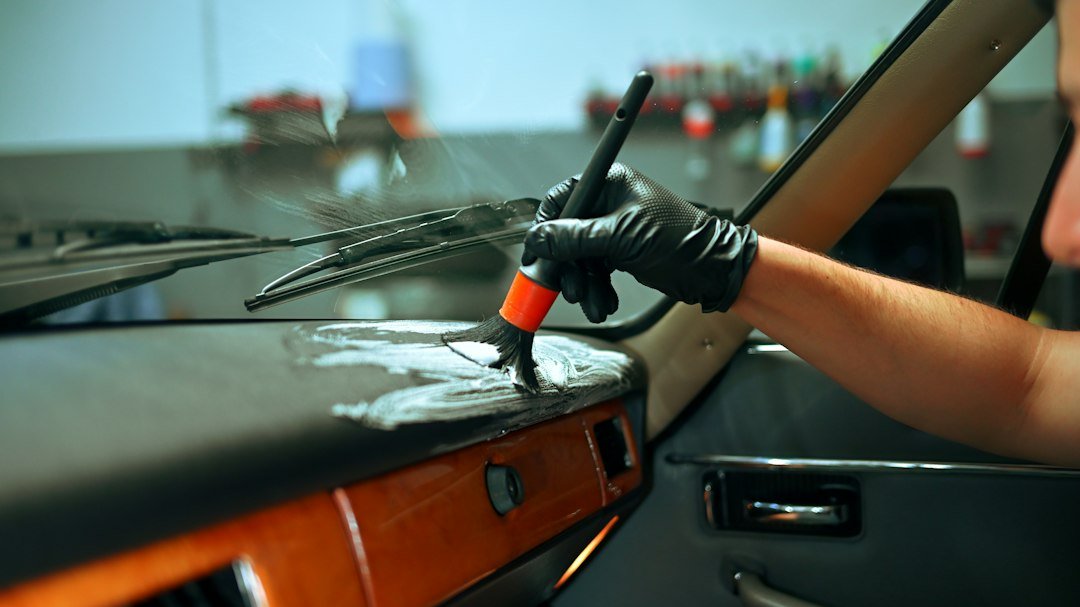
With the floors and fabric treated, a professional works across all the hard surfaces in the cabin. All hard surfaces are sprayed with a mild interior cleaner onto a microfiber cloth and wiped down. Detailing brushes reach tight spaces such as air vents and buttons. The process finishes with a UV protectant to prevent fading and cracking.
In my experience, the dashboard is where Colorado’s UV damage is most visible, and most preventable. UV is the number one cause of interior fading, leather degradation, and plastic brittleness. Applying a UV-blocking interior protectant to the dashboard and trim after cleaning dramatically slows this process. Colorado’s elevation intensifies UV exposure, meaning paint fade, clear coat breakdown, and plastic trim deterioration happen faster here than in many other states.
Steering Wheel and High-Touch Surface Sanitization
The steering wheel, gear shifter, door handles, and touchscreen surrounds receive focused attention. A study by CarRentals.com found that the average steering wheel has 629 colony-forming units (CFU) per square centimeter, compared to a public toilet seat’s 172 CFU. That makes proper sanitization of high-touch surfaces a legitimate health consideration for families and daily commuters alike.
Professional-grade interior cleaners are pH-balanced for automotive plastics and electronics, which means they clean effectively without damaging sensitive screens, piano-black trim, or soft-touch coatings that household cleaning sprays can permanently mark.
Stage 5: Leather Cleaning, Conditioning, and Protection
If the vehicle has leather seating, this is treated as an entirely separate process with its own sequence of products. Rushing it, or combining cleaning and conditioning into one step, produces poor results and can leave the leather dry and vulnerable.
The Two-Step Leather Protocol
After cleaning, the next step is conditioning. Conditioning replenishes the natural oils that keep leather supple and resistant to cracking. Without it, seats may feel dry and tight over time.
Professional detailers use high-quality, UV-resistant conditioners that penetrate deeply into the leather fibers. This not only restores softness and color but also creates a protective barrier against sunlight and future spills.
For leather interiors in Colorado, the conditioning step is not optional. The best leather conditioners include Vitamin E, lanolin, UV protection, and a non-greasy finish, and given Colorado’s sun intensity, UV blockers are particularly important to prevent fading and sun damage. In my experience, a leather seat that misses conditioning through even one Colorado summer will show surface cracking by autumn.
Pro Tip: Leather conditioning frequency should increase in Colorado’s dry climate. Regular conditioning is essential to keep leather soft, supple, and resistant to cracking. Apply a leather conditioner every two to three months, or more frequently if your car is exposed to harsh conditions.
Stage 6: Interior Glass and Final Inspection
Interior windows should be cleaned with a dedicated glass cleaner and a microfiber cloth. For a professional-quality result, roll down each window by a couple of inches to clean the edges of the glass as well.
A professional trick is to wipe outside glass vertically and inside glass horizontally, this allows you to instantly identify which side any remaining streak is on when you inspect the glass from inside the vehicle.
The Final Walkthrough
The detail finishes with a thorough inspection under different lighting. The detailer looks for missed spots, residue, or streaks and addresses them immediately. A professional will also check door jambs, the boot area, and seat pockets, areas that are easy to overlook but immediately noticeable to anyone getting into the vehicle.

Common Mistakes That Undermine Interior Cleaning Results
Understanding what can go wrong helps you get more from every detail service.
Using the Wrong Products on the Wrong Surfaces
For interior cleaning, products need to be matched to the substrate. For plastic and vinyl surfaces, an interior detailer with UV inhibitors is appropriate. For fabric seats, a carpet extractor or dedicated fabric foam cleaner lifts deep-seated stains. Applying an all-purpose cleaner to leather, or a fabric shampoo to a soft-touch plastic, can cause discoloration or surface damage that is expensive to correct.
Skipping the Drying Stage
Hot water extraction does leave interiors damp, and it is important that they are allowed to fully dry before closing up the vehicle or putting the protective floor mats back in. Sealing moisture inside a clean interior is one of the fastest routes to mildew odor, which then requires a separate odor treatment to resolve.
Waiting Too Long Between Details
Studies show that regularly maintained car interiors can last up to 50% longer compared to those that are neglected. For daily drivers in Colorado, a full interior deep clean every three to six months is a sensible interval. For daily drivers, a full detail every three to six months is a smart interval given the combination of UV exposure, hard water, and winter road chemicals.
What Does a Professional Interior Deep Clean Cost?
Pricing varies by vehicle size, condition, and the scope of work involved. Most detailers charge $150 to $350 for an interior detail, with the service typically covering vacuuming, dash and trim, carpets, mats, stains, glass, and leather care.
Interior car detailing generally costs $100 to $250 for a professional cleaning of a sedan, crossover, or SUV. A deep clean with upholstery extraction, difficult stains, or extensive pet-hair removal can reach $250 to $430 or more.
At FB Mobile Auto Detailing, mobile detailing near me in the Denver area means the service comes to your driveway or workplace, no drop-off, no waiting. For families and daily drivers who want a professional interior deep clean without rearranging their schedule, mobile detailing is the most practical option available.
The investment looks different when you consider the return. High-value inventory sees the largest return, $300 to $500 in detailing yields $2,000 to $3,000 in increased selling price. Mid-range vehicles benefit from $150 to $250 in detailing, adding $800 to $1,200 to resale values.
Frequently Asked Questions
How long does a professional interior deep clean take?
A professional interior detail follows a top-to-bottom, dry-to-wet sequence. Plan on three to five hours for a first-time full detail. Heavily soiled vehicles, those with significant pet hair, or cabins with extensive staining will take longer. Mobile detailing services like FB Mobile Auto Detailing will give you a time estimate based on the vehicle’s current condition before the appointment.
What is the difference between a basic interior clean and a deep clean?
A basic interior refresh covers vacuuming, a wipe-down of hard surfaces, and a glass clean. A deep clean goes substantially further: it includes hot water extraction for carpets and fabric seats, stain pre-treatment, leather cleaning and conditioning, UV-blocking protectant application, and a detailed pass across every crevice, vent, and door pocket in the cabin. DIY interior cleaning can produce a noticeably cleaner cabin when done well, covering vacuuming, wiping hard surfaces, cleaning glass, and light spot treatment. Professional detailing goes deeper, with hot water extraction, odour remediation, headliner-safe cleaning, and vent work that home tools rarely match.
How often should I have the interior professionally detailed in Colorado?
For daily drivers, a full detail every three to six months is a smart interval given the combination of UV exposure, hard water, and winter road chemicals. If you have young children, pets, or regularly eat in the car, leaning towards every three months keeps bacteria, staining, and odor from becoming a bigger problem to resolve later.
Will a professional detail remove odors as well as visible dirt?
A thorough deep clean removes most odors at source by extracting the contaminated material, food residue in carpet fibers, bacteria on seat fabric, and salt deposits from wet footwear. Hire a professional for heavy soiling, odors, sale preparation, or when you want a true reset without spending a full day. Persistent odors from smoke or biological spills may require a dedicated ozone or enzyme treatment as an add-on service.
Does professional interior detailing actually protect surfaces, or just clean them?
Both. The cleaning removes contaminants that accelerate material degradation. The protective finishes applied afterwards, UV-blocking dressings on plastics and vinyl, conditioner and UV protectant on leather, fabric sealants on cloth, slow the rate at which UV, heat, and daily use break down those surfaces. Regular interior detailing can reduce allergens and bacteria by approximately 50%, which translates into better overall health for you and your passengers. The cleaning and protection work together.
Sources
-
Car Interior Cleaning: Step-by-Step Guide, The Rag Company. Professional interior detailing sequence and methodology. https://theragcompany.com/blogs/detailing-how-tos/car-interior-cleaning-ultimate-step-by-step-guide-tools-best-products
-
Step-by-Step Flow Chart for Detailing Your Car, Chemical Guys. Interior top-to-bottom detailing workflow. https://www.chemicalguys.com/blogs/exterior-how-tos/detailing-flow-chart
-
A Step-by-Step Guide to Interior and Exterior Car Detailing, The Works Auto Center. Interior cleaning stages and surface-specific methods. https://www.theworksautocenter.com/a-step-by-step-guide-to-interior-and-exterior-car-detailing
-
How to Detail Your Car Interior: A Step-by-Step Guide, Mobile Detailing Expert. DIY vs professional interior detailing comparison. https://www.mobiledetailingexpert.com/blog/how-to-detail-car-interior-step-by-step-guide
-
Car Detailing Vs Car Wash: Which Is Better for Paint, Interior & Resale Value?, Middletown Life Magazine. Interior bacteria statistics and resale value data. https://lifestyle.middletownlifemagazine.com/story/679614/car-detailing-vs-car-wash-which-is-better-for-paint-interior-resale-value/
-
How Interior Detailing Increases Your Car’s Resale Value, AutoSpa 360. Resale value data and ROI analysis. A full interior detail might cost
-
How Does Hot-Water Extraction Work in Mobile Car Detailing?, Nathan’s Detailing. Professional extraction process and mechanics. https://nathansdetailing.com/how-does-hot-water-extraction-work-in-mobile-car-detailing/
-
Car Carpet Cleaning and Drying: Professional Techniques, Dennis Auto Details. Hot water extraction method and results. https://dennisautodetails.com/blog/interior-detailing/car-carpet-cleaning-professional-techniques/
-
Hot Water Extraction, EXL Auto Detail. Extraction process, temperatures, and drying guidance. https://www.exlautodetail.com/hot-water-extraction.html
-
Car Detailing Prices 2026, Housecall Pro. Interior detailing price ranges by service type. https://www.housecallpro.com/resources/how-much-to-charge-for-car-detailing/
-
How Much Does Interior Car Detailing Cost?, The Pricer. 2026 interior detailing price benchmarks. https://www.thepricer.org/how-much-does-interior-car-detailing-cost/
-
How to Detail a Car for Maximum Profit, CarJourney.io. Detailing ROI and resale value analysis. https://carjourney.io/blog/detail-car-maximum-profit-how-to-detail-car-for-maximum-profit
-
Car Interior Protection Denver, Extreme Auto Works. Denver UV intensity and interior damage data. https://extremeaw.com/interior-protection/
-
How Colorado’s Intense Sunlight Damages Your Car’s Paint, Watermill Wash. Colorado UV exposure and altitude data. https://www.watermillwash.com/post/how-colorado-s-intense-sunlight-damages-your-car-s-paint-and-how-to-stop-it
-
Winter Car Care in Colorado, Smoky Hill Auto. Road salt and interior damage in Colorado winters. https://smokyhillauto.com/winter-car-care-in-colorado/
-
Leather Seat Cleaning and Conditioning, Unexcelled Detailing. Leather conditioning protocol and UV protection. https://unexcelleddetailing.com/leather-seat-cleaning-and-conditioning-extend-the-life-of-your-interior/
-
Leather Seat Care: Conditioning and Treatment for Longevity, Steve’s Detailing. Colorado-specific leather conditioning guidance. https://www.stevesdetailing.net/leather-seat-care-conditioning-and-treatment-for-longevity/
-
Study Reveals the Inside of Your Car Is Dirtier Than the Average Toilet, Aston University. Car interior bacteria research findings. https://www.aston.ac.uk/latest-news/study-reveals-inside-your-car-dirtier-average-toilet
-
Steering Wheels Are Dirtier Than Toilets, CarRentals.com via SFGate. CFU bacteria counts by car interior surface. https://www.sfgate.com/travel/article/Disgusting-Your-car-s-steering-wheel-13559549.php
-
How Windsor, CO’s Climate Destroys Your Vehicle, Show Shine Detail. Colorado UV and detailing frequency guidance. https://www.showshinedetail.net/how-windsor-co-s-unique-climate-destroys-your-vehicle-and-how-to-stop-it
-
We Proudly serve the following cities and surrounding neighborhoods : Aurora , Cherry Hills Village Greenwood Village Castle Pines Lone Tree Castle Rock Highlands Ranch Centennial Parker Louisville Superior


