
Paint Decontamination Explained – What It Is and Why Your Car Needs It
You wash your car every couple of weeks, it looks clean, and yet the paint still feels rough to the touch, almost like fine sandpaper. If that sounds familiar, your car is carrying contamination that a standard wash will never remove. Your car’s paint is under attack every day, even if it looks clean. Tiny iron particles from brake dust, industrial fallout, and road debris embed themselves into the clear coat, causing gradual oxidation and damage. That is where paint decontamination comes in.
This is where paint decontamination comes into play. Decontamination is the process of removing the aforementioned contaminants from your car’s paint. For drivers in Colorado, where vehicles face a constant battle against extreme weather conditions, the state’s unique combination of high altitude, powerful UV rays, low humidity, hailstorms, snow, and freeze-thaw cycles puts immense stress on your vehicle’s exterior, decontamination is one of the most important services many owners have never heard of.
I’ve seen countless vehicles that look presentable on the outside but are quietly being degraded from the surface inward. This article explains what paint decontamination actually is, why your car almost certainly needs it, and how to know when it is time to act.

Key Takeaways
-
Regular washing leaves contamination behind: Car paint decontamination is the process of removing bonded contaminants that a regular wash can’t touch. Your paint picks up microscopic particles every time you drive. A standard wash removes loose dirt but leaves iron, tar, and fallout embedded in the clear coat.
-
Iron fallout is the biggest hidden threat: The primary source of automotive iron contamination is brake dust. Every time a vehicle brakes, the friction between brake pads and rotors generates fine metallic particles that become airborne and travel with road air currents. These particles are hot when generated and have enough kinetic energy to embed themselves into paint surfaces, both on the braking vehicle and on other vehicles nearby. Therefore, every vehicle on a shared road is accumulating iron, even if it brakes gently.
-
Decontamination should happen every 3-6 months: Decontaminate your car paint every 3 to 6 months. Frequency depends on driving conditions and exposure to pollutants. Regular decontamination prevents buildup and maintains paint clarity. If you park outdoors or commute daily in Denver traffic, aim for the shorter end of that range.
-
Skipping it damages protective coatings: Many people overlook the single most important factor that determines whether ceramic coating will live up to its promise: proper paint preparation. Without thorough decontamination, the coating cannot bond securely to the paint, leaving it vulnerable to premature failure and diminished performance.
-
Colorado’s environment accelerates contamination: Colorado’s high altitude means UV exposure is roughly 25% more intense than at sea level. This accelerates paint oxidation, fades interiors, and degrades rubber seals and trim pieces. Add winter road salt and magnesium chloride into the mix and the case for regular decontamination becomes even stronger.
Quick-Start Prioritisation Framework
| Your Situation | Recommended Service | Effort Level | Time to Results |
|---|---|---|---|
| New car, first detail | Chemical decon + clay bar | Low, Medium | Same day |
| Daily commuter, parked outside | Full decon every 3-4 months | Medium | Same day |
| Pre-ceramic coating prep | Full 3-stage decon + polish | High | 1-2 days |
| Post-winter recovery | Chemical decon + protective sealant | Medium | Same day |
| Light-use garaged vehicle | Decon every 6-12 months | Low | Same day |
Start here if you are:
-
A daily driver in Denver: Book a full decontamination every 3-4 months. Heavy traffic means high brake dust exposure and faster iron accumulation.
-
Preparing for ceramic coating: Complete decontamination before any coating application. Skipping this step voids the value of the product.
-
Noticing rough paint after washing: This is a reliable sign that contamination is already bonded. The touch test never lies, if it feels like sandpaper, it is time.
What Paint Contamination Actually Is
The Invisible Threat Bonded to Your Clear Coat
Most vehicle owners think of a clean car as one that has been recently washed. In reality, a freshly washed car can still carry thousands of microscopic contaminants bonded directly to the clear coat. Paint contamination refers to the accumulation of airborne pollutants, metal particles, and organic compounds on the surface of a vehicle’s paint. Over time, these contaminants can embed themselves into the clear coat, leading to a rough texture and a dull appearance. Regular car washes might not be sufficient to remove these embedded particles.
The most common offenders are iron particles from brake dust, tar and bitumen from road surfaces, industrial fallout, tree sap, bird droppings, and mineral deposits from water. These contaminants don’t just sit on the surface; they bond with the paint, leading to discoloration, rough textures, and even permanent staining if left untreated. That last detail matters enormously. Once contamination has worked deep enough into the clear coat, the damage cannot be washed away. It has to be corrected, which costs considerably more.
How Iron Fallout Gets Into Your Paint
Every time you press the brake pedal, your brake pads grind against the rotors. This friction releases hot metallic particles into the air. Those particles land on every surface of your vehicle, wheels, fenders, doors, hood, everything. Because these particles are heated when they are released, they embed into whatever surface they land on, including your paint. Your car generates its own brake dust, and it also picks up brake dust from every other vehicle driving in front of it.
The real reason you need to address iron fallout on car paintwork is that the corrosion accelerates the longer you leave it. Eventually, the particles will work all the way through the clear coat and begin damaging the base paint layer underneath. Once that happens, you only have one option once it gets to this point, respray the entire vehicle and apply a new clear coat. Compared to a professional decontamination service, a full respray is a dramatically more expensive outcome.
Pro Tip: Run a clean plastic bag over your freshly washed paint. If you feel texture, like running your fingers over fine sandpaper, that’s contamination. Smooth, glassy paint means you are clean. Gritty, rough paint means you need decontamination immediately.
The Three-Stage Decontamination Process
Stage 1: Pre-Wash and Deep Wash
Before any decontamination product touches your paint, the vehicle must be thoroughly washed to remove loose dirt and debris. The decontamination process is specifically designed to remove the kinds of harmful, corrosive contamination that a regular car wash can’t, so it stands to reason that you need to wash your car first to remove the kind of contamination that washing can. Skipping this step means loose grit can be dragged across the surface during the decontamination stages, creating micro-scratches that reduce the quality of the finished result.
Stage 2: Chemical Decontamination
Chemical decontamination uses specialist products to dissolve specific types of embedded contamination. There are two main types used at this stage.
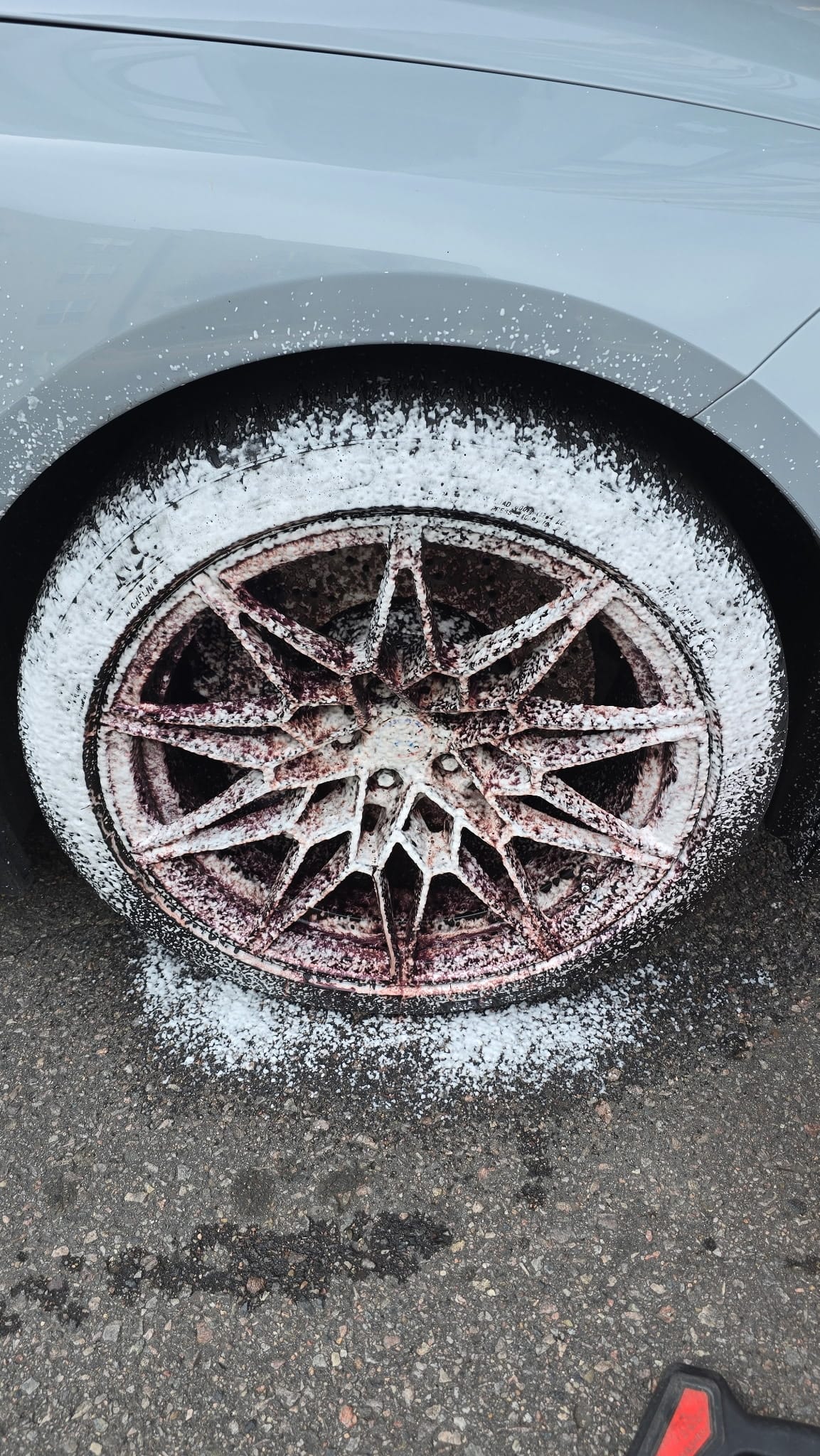
Iron removers are pH-neutral or near-neutral sprays that target ferrous metal particles. The active ingredient, usually ammonium thioglycolate or a similar iron-reactive compound, bonds with ferrous metal particles embedded in the clear coat and converts them into a water-soluble salt that rinses off. The reaction is visible: active ingredients react with iron particles, breaking their bond to the clear coat. The reaction typically turns the product purple, showing where iron is present. That purple colour is confirmation the chemistry is working, not a cause for alarm.
Tar removers handle organic contamination such as bitumen, asphalt residue, road film, and adhesive. These are designed to dissolve tar, adhesive residues, and similar substances without harming the paint. According to Auto Graph Detailing’s decontamination guide, both chemical steps should be completed before any mechanical work begins, because iron particles left in the paint will be dragged across the surface by a clay bar and cause scratches.
Stage 3: Mechanical Decontamination (Clay Bar)
Mechanical decontamination is a synonym for the term “claying,” which is an abrasive way of removing decontamination that withstood the chemicals that you tried before. To do so, you use a clay bar with soft, medium or heavy grade, that you carefully move over your car’s paint in conjunction with an appropriate lubrication.
Clay bar is mechanical. It physically grips and removes any bonded particle protruding from the clear coat, regardless of what the particle is made of. Non-ferrous brake dust, tree sap, asphalt residue, overspray, paint transfer, and bug remains all come off with clay but stay put after an iron treatment. This is why chemical decontamination and mechanical decontamination work together rather than being alternatives to each other. Each handles what the other cannot.
Pro Tip: According to 3D Products’ paint decontamination guide, always check for remaining roughness after the clay stage by running your fingers lightly across the panel. If you feel any roughness at all that panel needs to be decontaminated further before any protective product is applied.
The following walkthrough demonstrates each stage of the decontamination process in practice, showing how chemical and mechanical methods can be applied without the need for corrective polishing afterwards.
Why Colorado Drivers Need This More Than Most
Extreme Weather Means Accelerated Contamination
In my experience working with Colorado vehicle owners, the local environment adds several layers of urgency to regular paint decontamination that drivers in more temperate climates simply do not face.
Winter in Colorado means snow ice, and the constant use of road salt to keep the streets safe. Road salt, in particular, is highly corrosive and can eat away at your car’s paint, leading to rust and deterioration. The combination of snow and salt can create conditions where dirt and contaminants stick to your car’s surface, further damaging the paint.
It goes beyond basic salt. Magnesium chloride doesn’t just sit on your paint, it works its way into every crevice, including your undercarriage, wheel wells, and even electrical wiring. Left unchecked, it causes rust and wiring corrosion that can lead to expensive repairs down the road. A thorough decontamination wash in spring, after the salting season ends, is one of the most valuable services any Colorado driver can invest in.
Summer brings a different set of problems. Summer brings relief from the salt, but introduces new challenges. Colorado’s high altitude means UV exposure is roughly 25% more intense than at sea level. This accelerates paint oxidation, fades interiors, and degrades rubber seals and trim pieces. Combined with the contaminants that accumulate during warmer months, insects, tree sap, pollen, and road tar softened by heat, summer is just as demanding on your paint as winter. Therefore, plan two decontamination services as a minimum: one in late autumn and one in early spring, according to Auto Finesse’s detailing guide.
Decontamination Before Colorado Winters
At the very least, detailing experts recommend decontaminating your paint at least twice a year: once before the winter, to get it ready for the protection layers needed to see out the cold season. And once after winter, in order to eradicate the harshest, and most harmful, contamination prior to getting your car looking its best for the spring and summer. For Colorado drivers, that pre-winter decontamination is critical. Applying a fresh protective sealant or ceramic coating over contaminated paint will trap the contamination underneath, reducing the protection the product can offer and accelerating long-term damage.
Pro Tip: Twice annually suits cars that are garaged overnight and driven mainly on open roads. Quarterly is a better target if you park outdoors, live near industrial areas, or sit in heavy traffic daily. Denver commuters who drive I-25 or I-70 daily should lean towards quarterly decontamination given the high brake dust environment those corridors create.

Decontamination as a Foundation for Lasting Protection
Why Nothing Works Without a Clean Surface
I’ve found that many vehicle owners invest in wax, sealant, or ceramic coatings and then wonder why the results are disappointing. The answer is almost always surface preparation. Ceramic coatings bond directly to the paint surface. Any contamination, polishing oils, water spots, or paint defects left behind can affect coating durability, gloss, hydrophobic performance, and long-term protection.
If you are preparing a surface for ceramic coating or paint protection film, contaminated paint will compromise adhesion and trap problems under the product. You will see hazing, poor bonding, and premature failure. This means that skipping decontamination before a protective coating does not just reduce the coating’s effectiveness; it can actively make the paint condition worse by sealing contamination in place.
Professional ceramic coating preparation typically includes washing, chemical decontamination, mechanical decontamination, paint inspection, paint correction when necessary, and final panel preparation. Most experienced detailers agree that preparation has a greater impact on coating performance than the coating application itself. That is a striking point worth repeating: the preparation stage matters more than the coating product. A budget coating on a properly prepared surface will outperform an expensive coating applied to contaminated paint.
What to Expect From a Professional Service
Exterior auto detailing typically costs $120-$300 and includes decontamination, surface refinement, and protective layers that reduce UV exposure, road salt damage, and environmental fallout. For a standalone decontamination service as part of a full exterior detail, exterior detailing ranges from $150 for small vehicles to $260 for large SUVs, utilising clay bar decontamination, machine sealing, and wheel cleaning.
Viewed against the alternative, a full paint respray, which can run into thousands of pounds when iron contamination is left until it penetrates the base coat, a twice-yearly decontamination service is a straightforward investment in protecting your vehicle’s value. Teams like FB Mobile Auto Detailing come directly to you, which removes one of the most common reasons owners delay this type of service.
Common Mistakes That Make Contamination Worse
Polishing Over Contaminated Paint
One of the biggest issues is paint correction. When a car isn’t fully decontaminated, attempting to correct its paint can cause more harm than good. When the car’s surface is littered with contamination, you run the risk of grinding the contaminants into the paint while using a polishing pad, causing unsightly scratches.
This is one of the most expensive mistakes an enthusiastic DIY detailer can make. The polishing pad does not distinguish between paint imperfections and iron particles. It drags both across the clear coat. The result is fresh scratches and micro-marring on top of the original contamination, a problem that now requires more aggressive correction to fix.
Applying Wax or Sealant Without Decontaminating First
Washing your car removes dirt – but that doesn’t mean your paint is fully clean. If you skip decontamination, you’re likely applying waxes or ceramic sprays on top of invisible contaminants. Wax applied over contamination bonds to the contamination, not to the paint. The protection it offers is therefore sitting on an unstable base and will not last as long or perform as well as it should.
Using Regular Car Soap as a Decontamination Product
You should not use regular car soap to decontaminate your car. Regular car soaps are not designed to remove bonded contaminants. Standard pH-neutral shampoos are formulated to lift loose dirt safely without stripping wax or sealant. That same gentleness means they cannot dissolve or dislodge particles that are chemically bonded to the clear coat. Only dedicated iron removers, tar removers, and clay media have the right chemistry and mechanics to do that job.
Frequently Asked Questions
What is paint decontamination and is it the same as a car wash?
Paint decontamination removes bonded contaminants that a normal car wash cannot touch. A car wash removes loose dirt, dust, and grime sitting on the surface. Decontamination uses chemical products to dissolve embedded iron, tar, and fallout, followed by a clay bar to physically lift what the chemicals could not reach. The two processes are complementary; you wash first, then decontaminate.
How can I tell if my car needs decontamination?
Run your hand over the paint after washing. If you feel a gritty or sandpaper-like texture, your car likely has paint contamination. Visual cues may include small rust-coloured spots or a lack of smoothness in the paint. If the paint feels smooth and glassy, it is in good shape. If it feels rough anywhere, book a decontamination service before applying any wax, sealant, or coating.
How often should I get my car decontaminated in Colorado?
Climate, driving habits, storage conditions, and brake dust levels all influence how quickly contamination builds up. For most Colorado daily drivers, a decontamination service every 3-4 months is appropriate given the combination of heavy urban traffic, high-altitude UV exposure, and seasonal road salt. Garaged vehicles driven lightly on weekends can stretch to twice a year. Always decontaminate before applying any new protective coating and after every winter season.
Does my car need decontamination even if it has a ceramic coating?
Yes. Vehicles with ceramic coatings still need decontamination. A ceramic coating slows the rate at which contaminants bond to the surface, but it does not prevent accumulation entirely. Over time, iron and fallout will still settle onto the coating. Regular maintenance decontamination keeps the coating performing at its best and extends its service life.
Is paint decontamination something I can do at home?
The basic steps, iron remover, tar remover, and clay bar, can be performed at home with the right products and technique. However, it’s important to note that these processes should be done carefully and with the right products, as using incorrect methods or abrasive materials could damage the paint. For vehicles that have never been decontaminated, or those preparing for ceramic coating or paint correction, a professional service provides better results and removes the risk of inadvertent damage from incorrect technique or product selection.
The Bottom Line
Paint decontamination is one of the most overlooked services in vehicle care, and one of the most consequential. Every drive adds contamination to your paint. Every winter in Colorado deposits road salt, magnesium chloride, and fallout that a standard car wash cannot remove. And every time you apply wax or sealant to contaminated paint, you are reducing the protection your car actually receives.
The approach I always recommend to Colorado vehicle owners is straightforward: treat decontamination as a routine maintenance service on the same level as an oil change. Do it every 3-6 months, do it before every winter, and always do it before any coating or protective product is applied. Your paint will last longer, look better, and protect the vehicle’s value more effectively.
If you would like to understand what a professional decontamination service would involve for your specific vehicle, FB Mobile Auto Detailing offers mobile services across the Denver area, bringing the full decontamination process to your driveway.
Sources
-
The Ultimate Guide to Car Paint Decontamination, 3D Products. Step-by-step decontamination process and contamination identification. https://3dproducts.com/blogs/detailing-tips-and-guides/the-ultimate-guide-to-car-paint-decontamination
-
How to Safely Decontaminate Your Paintwork, Auto Finesse. Decontamination frequency guidance and 3-stage process overview. https://www.autofinesse.com/blogs/car-detailing-guides/how-to-safely-decontaminate-your-paintwork
-
Iron Contamination on Car Paint: What It Is and Why It Matters, KlenCars. Iron fallout sources and brake dust mechanics. The primary source of automotive
-
Why Iron Contamination is Ruining Your Paint, HyperClean Store. Contamination bonding mechanisms and damage progression. https://hypercleanstore.com/blogs/news/why-iron-contamination-is-ruining-your-paint-and-how-to-fix-it
-
Clay Bar vs Iron Decontamination: Do You Need Both?, Mobile Detailing Expert. Chemical vs mechanical decontamination comparison. https://www.mobiledetailingexpert.com/blog/clay-bar-vs-iron-decontamination
-
Why Paint Decontamination Is Key Before Ceramic Coating, LeJeune Ceramic Coating. Pre-coating preparation requirements and bonding mechanics. https://www.lejeuneceramiccoating.com/why-paint-decontamination-is-key-before-ceramic-coating
-
Surface Prep Before Ceramic Coating, BrilliaTech. Multi-stage preparation process and coating adhesion factors. https://www.brilliatech.com/blogs/surface-prep-before-ceramic-coating/
-
How Colorado’s Climate and Weather Impact Auto Paint, Yoder Collision Network. Colorado UV, salt, and weather damage to automotive paint. https://yodercollisionnetwork.com/auto-body-repair/how-colorados-climate-and-weather-impact-auto-paint-signs-and-repairs/
-
Colorado Weather and Car Wash Protection Tips, Rocket Express Car Wash. High-altitude UV exposure data and seasonal paint threats. https://www.rocketexpresscarwash.com/colorado-weather-car-wash-protection-tips/
-
How Proper Detailing Protects Your Car’s Paint from Colorado Weather, Heights Detailing. Road salt corrosion and seasonal protection strategies. https://www.heightsdetailing.com/how-proper-detailing-protects-your-cars-paint-from-colorado-weather/
-
How to Decontaminate Car Paint, Jennychem. Decontamination frequency guidance and process walkthrough. https://www.jennychem.com/blogs/news/how-to-decontaminate-car-paint
-
How to Decontaminate Your Car’s Paint, Auto Obsessed. Frequency guidelines by driving habits and parking environment. https://www.autoobsessed.com/blogs/how-to/how-to-decontaminate-your-cars-paint
-
How Often Should You Decontaminate Your Car?, Detailed Image. Climate and driving habit impact on contamination build-up rate. Climate, driving habits, storage
-
Exterior Auto Detailing Cost Guide, ACT Customs. 2026 pricing data for exterior decontamination services. https://www.actcustoms.com/how-much-does-auto-detailing-cost
-
Exterior Detailing Price Breakdown, Xtreme Detailing USA. Clay bar decontamination service pricing by vehicle size. Clay bar decontamination pricing varies by vehicle size. Clay bar decontamination pricing varies by vehicle size, with larger vehicles costing £25-£100 more than sedans due to increased surface area and labour time.
-
Paint Decontamination: What Is It and How Does It Work?, Auto Graph Detailing. Three-stage decontamination process including chemical and mechanical stages. https://auto-graph.eu/en/blog/paint-decontamination-what-is-it-and-how-does-it-work/
-
Iron Fallout and Brake Dust: What They Do to Your Paint, EuroLuxe Detailing. Long-term contamination accumulation and paint degradation mechanisms. https://euroluxedetailing.com/blog/iron-fallout-brake-dust-paint-damage-explained/


